


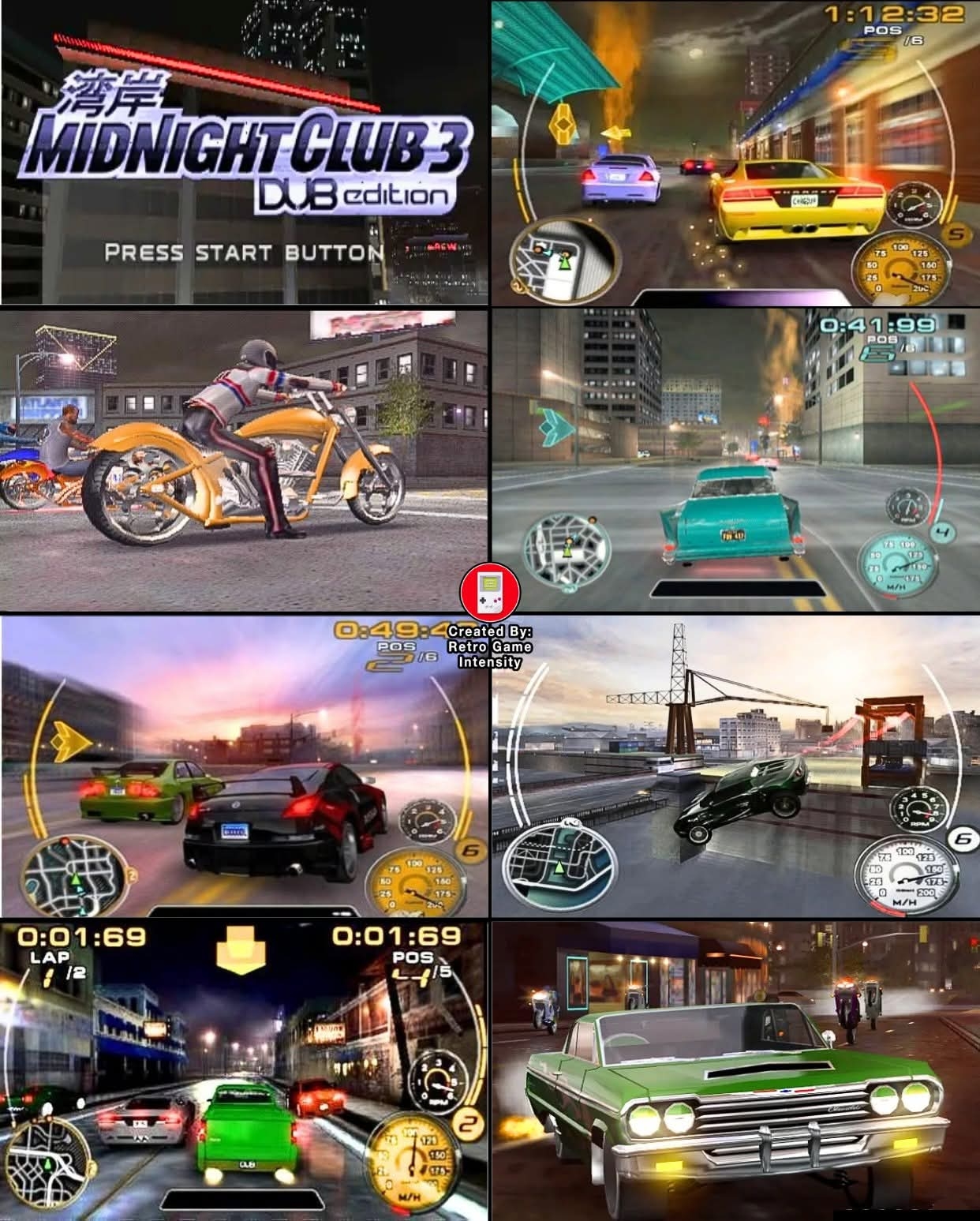
Midnight Club 3: DUB Edition took Rockstar’s open-city racing formula and drenched it in early-2000s car culture. With outrageous customization, motorcycles, open routes, and blistering speed, every race felt like organized chaos through city streets.
Three Cities, No Fixed Route: San Diego, Atlanta, and Detroit served as massive racing playgrounds filled with shortcuts, jumps, alleys, and alternate paths. Learning the streets could be just as important as having the fastest ride.
Customization Went Deep: Body kits, rims, paint, exhausts, hydraulics, and performance upgrades gave players enormous freedom to personalize their garage. The partnership with DUB Magazine helped give the game its unmistakable tuner-culture identity.
More Than Just Cars: The roster included tuners, muscle cars, exotics, SUVs, trucks, choppers, and sport bikes. Switching vehicle classes could completely change the rhythm of a race.
Arcade Racing at Full Speed: Slipstream Turbo, Zone, and Agro abilities gave different vehicle classes special advantages once unlocked. Combined with open checkpoints and heavy traffic, they created some wonderfully unpredictable finishes.
The Remix Got Even Bigger: Midnight Club 3: DUB Edition Remix later expanded the experience with Tokyo, additional vehicles, races, and music. Rather than being a completely separate sequel, it became an enlarged version of an already packed racing game.
Midnight Club 3: DUB Edition was pure early-2000s street-racing attitude packed onto the PS2. Its speed, customization, soundtrack, and open-city freedom made every customized ride feel like it belonged to the player.
Midnight Club 3: DUB Edition took Rockstar’s open-city racing formula and drenched it in early-2000s car culture. With outrageous customization, motorcycles, open routes, and blistering speed, every race felt like organized chaos through city streets.
🏙️ Three Cities, No Fixed Route: San Diego, Atlanta, and Detroit served as massive racing playgrounds filled with shortcuts, jumps, alleys, and alternate paths. Learning the streets could be just as important as having the fastest ride.
🔧 Customization Went Deep: Body kits, rims, paint, exhausts, hydraulics, and performance upgrades gave players enormous freedom to personalize their garage. The partnership with DUB Magazine helped give the game its unmistakable tuner-culture identity.
🏍️ More Than Just Cars: The roster included tuners, muscle cars, exotics, SUVs, trucks, choppers, and sport bikes. Switching vehicle classes could completely change the rhythm of a race.
🔥 Arcade Racing at Full Speed: Slipstream Turbo, Zone, and Agro abilities gave different vehicle classes special advantages once unlocked. Combined with open checkpoints and heavy traffic, they created some wonderfully unpredictable finishes.
📀 The Remix Got Even Bigger: Midnight Club 3: DUB Edition Remix later expanded the experience with Tokyo, additional vehicles, races, and music. Rather than being a completely separate sequel, it became an enlarged version of an already packed racing game.
Midnight Club 3: DUB Edition was pure early-2000s street-racing attitude packed onto the PS2. Its speed, customization, soundtrack, and open-city freedom made every customized ride feel like it belonged to the player.
0 Commentarii
0 Distribuiri
69 Views

 English
 Arabic
 French
 Spanish
 Portuguese
 Deutsch
 Turkish
 Dutch
 Italiano
 Russian
 Portuguese (Brazil)
 Greek