



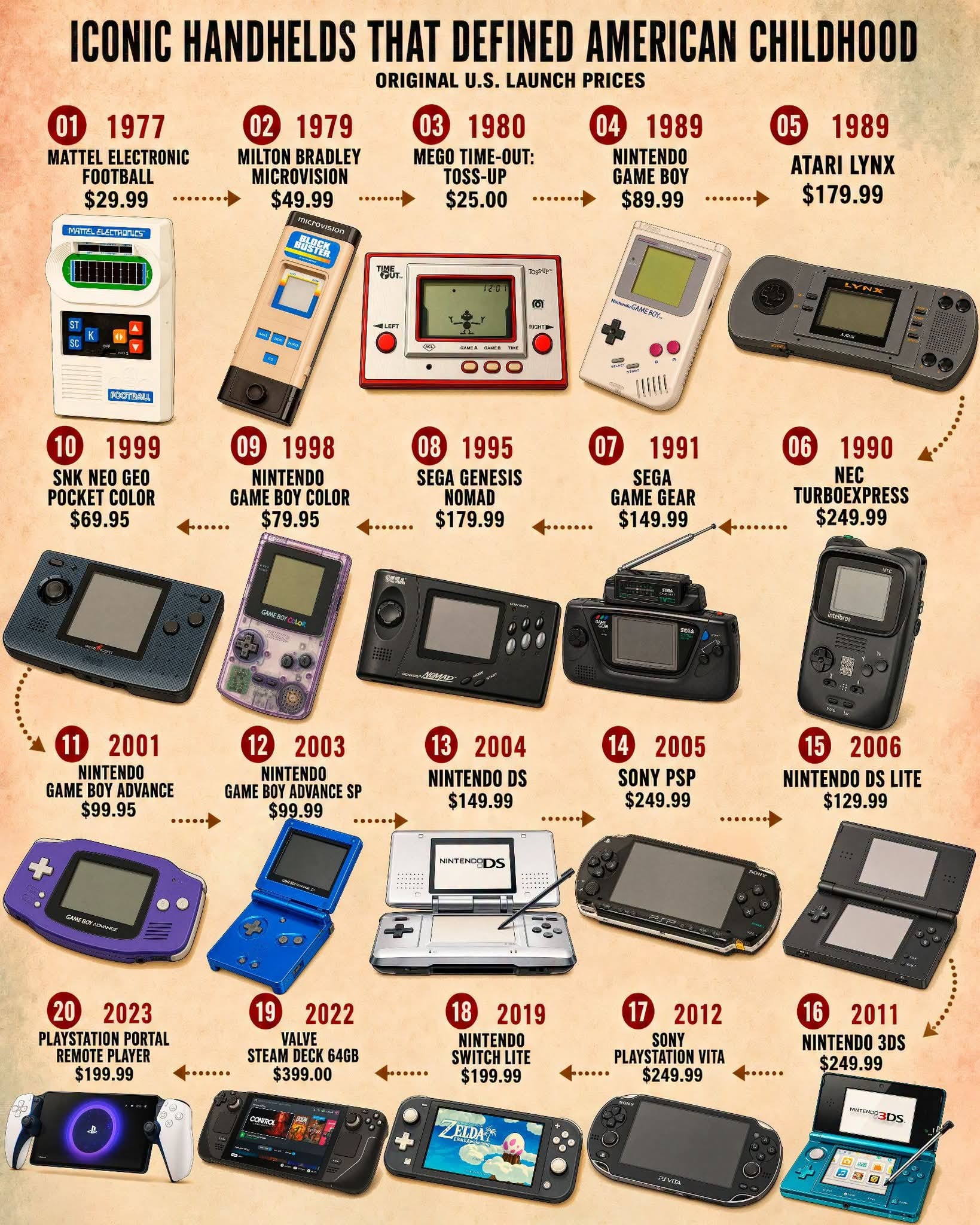
In 1989, America got the Atari Lynx and Nintendo Game Boy. Two years later, Sega brought over the Game Gear. The Lynx and Game Gear offered bright color screens, but the biggest winner was a gray brick with a blurry green display—and it went on to sell over 100 million units.
The Atari Lynx and Sega Game Gear looked like the future. The Game Boy looked more like a calculator. But those colorful machines could drain six AA batteries in just a few hours, while the humble Game Boy could run for around 30 hours on four. Millions of kids on long car rides quickly understood which one they wanted in their hands. Sometimes the smartest technology is simply the one that keeps working.
Every device in this journey tells a story like that. Mattel Electronic Football turned a few red blips into a national obsession for $29.99. The Sega Nomad let players carry an entire Genesis library in a backpack. The Game Boy Advance SP finally gave us a screen we could see in the dark, and its folding design felt impossibly futuristic in 2003.
Then came touch screens, dual screens, discs, and analog sticks. The Nintendo DS and Sony PSP became two of the defining handhelds of the 2000s—and somehow, both found enormous audiences. Today, devices like the Steam Deck can place a full PC gaming experience in your hands, something a child squinting at a Microvision screen in 1979 could hardly have imagined.
Twenty devices. Nearly five decades. Countless batteries, long car rides, and unforgettable gaming memories.
#RetroGaming #HandheldGaming #GamingNostalgia #GameBoy #AmericanGamingHistory
The Atari Lynx and Sega Game Gear looked like the future. The Game Boy looked more like a calculator. But those colorful machines could drain six AA batteries in just a few hours, while the humble Game Boy could run for around 30 hours on four. Millions of kids on long car rides quickly understood which one they wanted in their hands. Sometimes the smartest technology is simply the one that keeps working.
Every device in this journey tells a story like that. Mattel Electronic Football turned a few red blips into a national obsession for $29.99. The Sega Nomad let players carry an entire Genesis library in a backpack. The Game Boy Advance SP finally gave us a screen we could see in the dark, and its folding design felt impossibly futuristic in 2003.
Then came touch screens, dual screens, discs, and analog sticks. The Nintendo DS and Sony PSP became two of the defining handhelds of the 2000s—and somehow, both found enormous audiences. Today, devices like the Steam Deck can place a full PC gaming experience in your hands, something a child squinting at a Microvision screen in 1979 could hardly have imagined.
Twenty devices. Nearly five decades. Countless batteries, long car rides, and unforgettable gaming memories.
#RetroGaming #HandheldGaming #GamingNostalgia #GameBoy #AmericanGamingHistory
🎮 In 1989, America got the Atari Lynx and Nintendo Game Boy. Two years later, Sega brought over the Game Gear. The Lynx and Game Gear offered bright color screens, but the biggest winner was a gray brick with a blurry green display—and it went on to sell over 100 million units.
The Atari Lynx and Sega Game Gear looked like the future. The Game Boy looked more like a calculator. 🔋 But those colorful machines could drain six AA batteries in just a few hours, while the humble Game Boy could run for around 30 hours on four. Millions of kids on long car rides quickly understood which one they wanted in their hands. Sometimes the smartest technology is simply the one that keeps working.
Every device in this journey tells a story like that. Mattel Electronic Football turned a few red blips into a national obsession for $29.99. 🏈 The Sega Nomad let players carry an entire Genesis library in a backpack. The Game Boy Advance SP finally gave us a screen we could see in the dark, and its folding design felt impossibly futuristic in 2003.
Then came touch screens, dual screens, discs, and analog sticks. 🕹️ The Nintendo DS and Sony PSP became two of the defining handhelds of the 2000s—and somehow, both found enormous audiences. Today, devices like the Steam Deck can place a full PC gaming experience in your hands, something a child squinting at a Microvision screen in 1979 could hardly have imagined.
Twenty devices. Nearly five decades. Countless batteries, long car rides, and unforgettable gaming memories. ✨
#RetroGaming #HandheldGaming #GamingNostalgia #GameBoy #AmericanGamingHistory
0 Reacties
0 aandelen
809 Views

 English
 Arabic
 French
 Spanish
 Portuguese
 Deutsch
 Turkish
 Italiano
 Russian
 Romaian
 Portuguese (Brazil)
 Greek
Greek